3.4.1. Device Security
3.4.1.1. Security Overview
The J7200 SoC offers a comprehensive set of security features that protect embedded Linux applications. This guide offers a starting point to understand and implement these capabilities as part of product development, with the following advantages:
Hardware-backed security - Leverages built-in security hardware for robust protection
Defense in-depth - Implements security at many levels including hardware, firmware, software to protect against wide range of attacks
Industry standards compliance - Incorporates security measures such as secure boot, TrustZone, and crypto acceleration that can help meet requirements in standards such as IEC 62443 and NIST guidelines
Flexible implementation - Allows security features that can be tailored to specific application needs
3.4.1.2. Security Domains
Below is an overview of the security framework’s main domains:
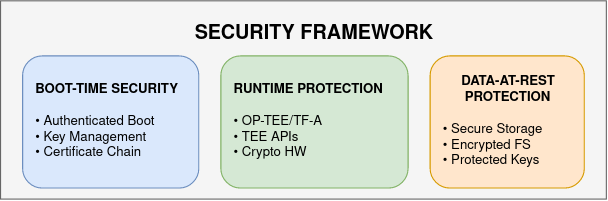
These security domains create a chain of trust protecting the J7200 SoC from boot through runtime and storage, ensuring system integrity and data confidentiality.
3.4.1.3. Security Features at a Glance
The following table lists some of the key Security Features:
Security Feature |
Description |
Links |
|---|---|---|
Crypto Acceleration |
Hardware driver support for cryptographic algorithms |
|
Secure Storage |
Protection mechanisms for sensitive data |
|
Trusted Execution |
Implementation of secure monitor (EL3) firmware that manages the secure boot process and TrustZone transitions |
|
Trusted Execution Environment that enables isolated execution of security-sensitive applications and services |
||
Memory Firewalls |
Prevents unauthorized access through hardware-enforced security boundaries |
memory-firewalls |